
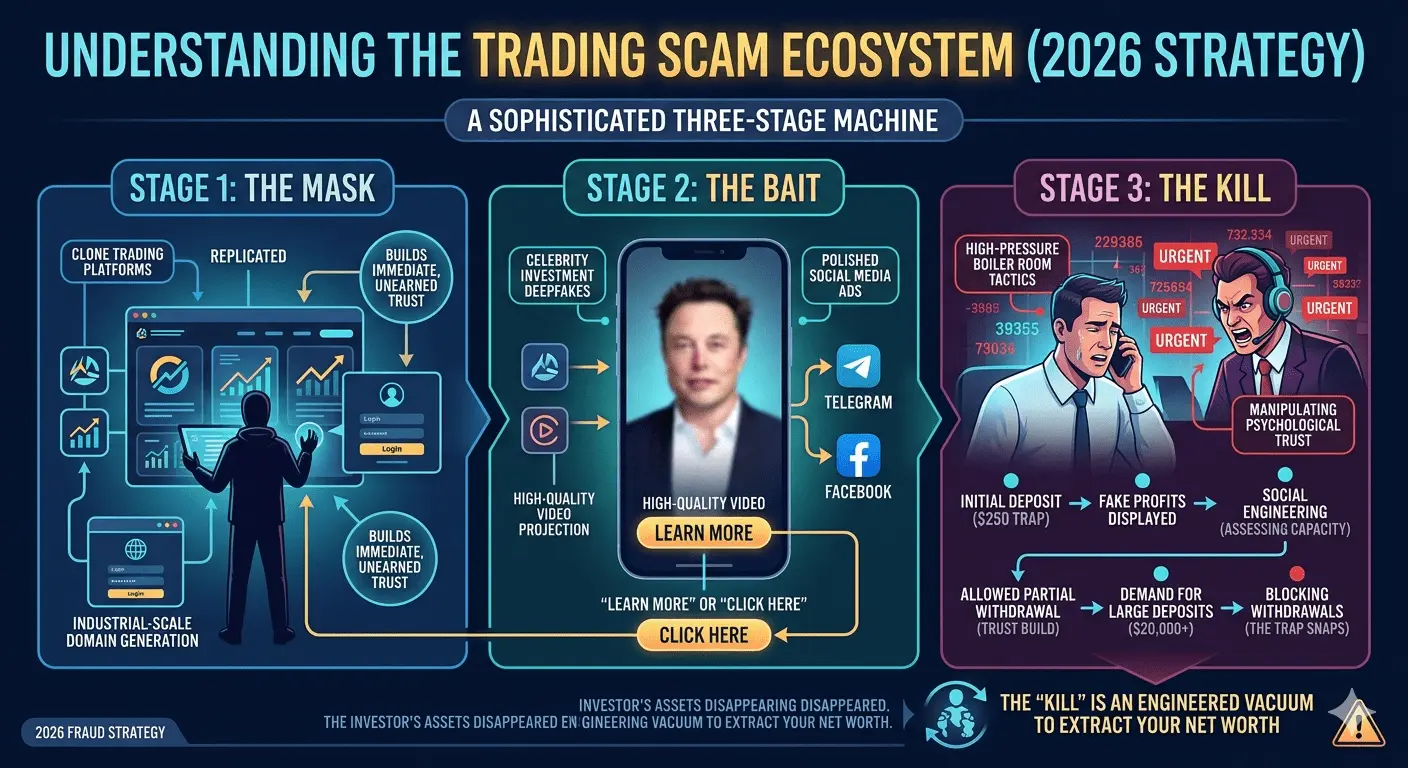
Executive Summary: Modern trading fraud in 2026 operates as a sophisticated trading scam ecosystem. This three-stage machine consists of:
- The mask, utilizing clone trading platforms
- The bait, leveraging celebrity investment deepfakes on social media;
- The kill, high-pressure boiler room “the kill” tactics that manipulate psychological trust to escalate a small deposit into massive losses.
Layer | Stage Name | Primary Tactic | Goal |
1 | The Mask | Clone Platforms: Industrial-scale generation of AI-designed websites that mimic regulated brokers. | Establish unearned trust through professional, familiar visual design. |
2 | The Bait | Deepfake Funnels: Using AI-generated videos of celebrities (like Elon Musk) on social media ads. | Capture contact information and lower psychological defenses. |
3 | The Kill | The Boiler Room: Human “advisors” use social engineering and “partial withdrawals” to prove legitimacy. | Escalate a $250 “test” deposit into 5 or 6-figure losses ($20k+). |
4 | The Squeeze | Recovery Fraud: Re-targeting victims with fake “recovery agencies” (e.g., CNC Intelligence). | Extract one final payment from a victim already in financial distress. |
In 2026, online trading fraud is no longer a single website; it is an integrated trading scam ecosystem comprising multiple domains and professional criminal networks. To protect your capital, you must understand the four layers of this trap:
1. How Clone Trading Platforms Power the Trading Scam Ecosystem
The first layer is the launch of the clones, also known as the “masks.” This is where the deception begins. Scammers launch clone trading platforms that look absolutely identical—pixel-for-pixel—to regulated brokers, banks, crypto exchanges, and other major financial services providers.
It’s all designed to build immediate, unearned trust the moment you land on the page. But they don’t just stop at one site. Criminal networks now utilize specialized algorithms and AI to generate and register bulk domain names at an industrial scale.
By using these automated systems, they can spin up hundreds of unique, legitimate-sounding URLs in minutes as a massive contingency plan.
That way, if one site gets flagged or pulled down by authorities, the rest of the trading scam ecosystem continues to operate uninterrupted. They aren’t worried about being caught; they are simply cycling through an endless supply of AI-generated domains.
2. Viral Funnels Driven by Celebrity Investment Deepfakes
The second layer consists of the “funnels”, or the “bait.” Think of this as the delivery system.
Scammers actually buy up ad space on reputable sites or those with high traffic levels, and social media platforms like Telegram or Facebook just to expand their outreach.
This is where you’ll see those “life-changing” videos, highly polished celebrity investment deepfakes of figures like Elon Musk. All they want is your contact info to get you into their system.
Every one of these ads has a “Learn More”, “Click Here for More”, or any other similar button that links directly back to those clone websites. Your guard is totally down by the time you click through since you’ve already seen a famous face endorsing the so-called investment opportunity.
3. Entering the Boiler Room “The Kill” Within the Trading Scam Ecosystem
The third layer is the call centers, what we call the “boiler room” or “the kill.” Now that the scammers have your contact info, the real pressure begins. You’re no longer just looking at a screen; you’re dealing with an actual human being whose only job is to gain your trust and talk you into making your initial deposit—the $250 trading trap.
They usually start small, asking for just a modest amount to let you “test the waters.” But don’t let that low number fool you; it’s the exact moment the trap snaps shut. Once that money is in, they’ll manipulate the trading platform to display massive, fake profits.
To cement this illusion, scammers often use social engineering to study your financial background. If they realize you have the capacity for high-value transfers, they may even allow you to withdraw a portion of those “profits” early on. This isn’t generosity; it is a calculated move to earn your absolute trust.
That’s when your so-called ‘financial advisor’ strikes. They’ll urge you to invest $20,000 or more to ‘unlock’ even bigger returns. But the moment you try to take your money out for real, the script changes. Suddenly, there are ‘problems’ like fabricated taxes or processing fees. But here’s the cold truth: no matter how many fees you pay, you’ll never see a cent of it again.
For example, I am currently assisting a victim who was allowed to withdraw just over $8000 AUD in ‘profits’ generated from a small initial deposit. This was a calculated move to build trust; once he believed the platform, sbglobal.io, (Stonebridge Ventures/SB Global), was legitimate, he was lured into depositing a six-figure sum of nearly $100,000 AUD.
4. Identifying and Avoiding Recovery Room Fraud
Once the scammers realize you suspect the fraud, they may pass or even sell your details to a questionable entity posing as a “recovery agency.” This is known as recovery room fraud.
CNC Intelligence (cncintel.com) is a good example of such disreputable firms. These entities typically request an upfront payment to recover the lost funds, but after the fee is paid, no recovery ever takes place, leaving victims further out of pocket. In this final stage of the trading scam ecosystem, the goal is simply to squeeze the victim one last time.
Frequently Asked Questions (FAQ)
1. How can I spot celebrity investment deepfakes? In 2026, celebrity investment deepfakes are incredibly realistic. Look for unnatural mouth movements, slight glitches in the video quality, or “too good to be true” promises. Remember: legitimate billionaires like Elon Musk do not promote “passive income” schemes through Telegram or Facebook ads.
2. Is the $250 trading trap real? Yes. The $250 trading trap is a psychological tactic where scammers ask for a small, low-risk deposit to gain your trust. Once you pay, they show you fake profits to convince you to invest much larger sums, which you will never be able to withdraw.
3. Do scammers ever let you withdraw fake profits? Yes. To build trust within the trading scam ecosystem, scammers will often allow a victim to withdraw a portion of their money early on. While this might be a small $50 AUD ‘test,’ sophisticated syndicates may even allow a withdrawal of several thousand dollars if they believe you have the capacity to later deposit six-figure sums. This “proof of liquidity” is a psychological trick designed to make you believe the platform is legitimate so that you feel comfortable investing much larger sums later.
Final Verdict: The Reality of the Modern Trading Trap
The trading scam ecosystem is not designed for you to win; it is an engineered vacuum meant to extract every cent of your net worth. In 2026, the technology, from celebrity investment deepfakes to clone trading platforms, is so convincing that even seasoned investors are falling for the $250 trading trap.
The “kill” happens the moment you believe the fake profits on your screen are real. Remember: legitimate brokers do not find you through Telegram ads, and they never use high-pressure boiler room tactics to demand more capital.
If you’ve already lost money, do not double your losses by falling for recovery room fraud. The only way to win is to refuse to play their game.
Report Scam
Have you encountered a suspicious site? Don’t let them move to the next layer of the trap. Report the scam here to help us track, expose, and shut down these fraudulent domains.