Table of Contents
- Deriv Trading Security & Broker Overview
- 1. Proprietary Assets: The Reality of Synthetic Indices
- 2. Common Scams & Policy Pitfalls in Deriv Trading
- 3. How to Safely Test or Use Deriv
- Report a Scam
- Is Deriv Trading Safe?
- Deriv Trading FAQs
Deriv (formerly Binary.com) has become one of the most popular brokers for trading synthetic indices, forex, and automated bots. However, before you open an account or make a deposit, you need to understand the real risks involved.
In this independent review, we audit Deriv’s licensing structure, withdrawal policies, and common third-party scam threats.
Deriv Trading Security & Broker Overview
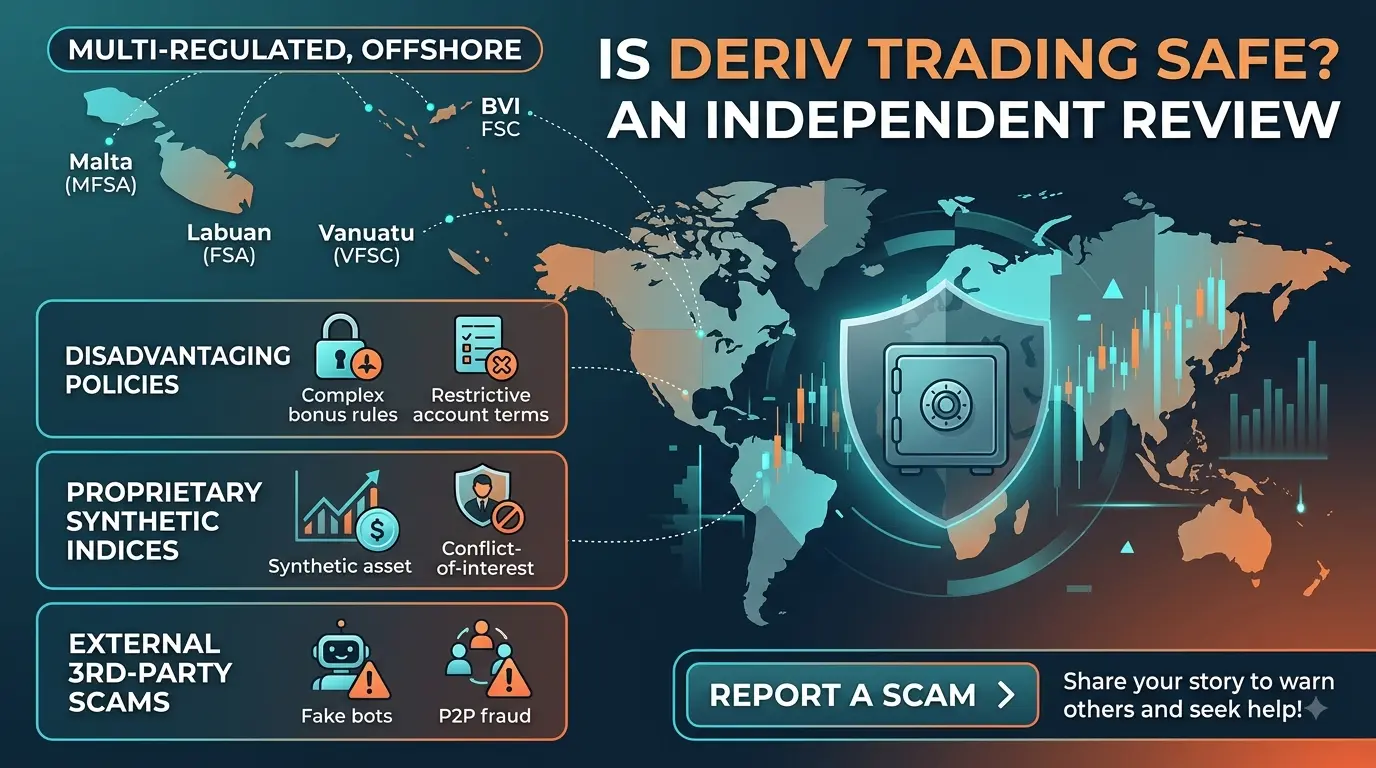
As covered in our detailed Deriv review and license verification, this entity is an established, multi-regulated offshore broker operating through subsidiaries in jurisdictions like Malta (MFSA), Labuan (FSA), Vanuatu (VFSC), and the British Virgin Islands (BVI FSC).
However, being a legitimate broker does not mean Deriv trading is risk-free. Most complaints labeling Deriv a “scam” stem from two main sources: third-party fraudsters exploiting the ecosystem and traders falling foul of Deriv’s strict internal policies and proprietary market structures.
1. Proprietary Assets: The Reality of Synthetic Indices
A primary source of trader losses during Deriv trading comes from its proprietary Synthetic Indices (such as Volatility 75 (V75), Boom 1000 index, and Crash 500).
Unlike traditional Forex currency pairs or stock indices, synthetic assets do not track real-world financial markets. Instead, they are generated by Deriv’s internal cryptographic algorithms.
- Algorithmically Generated: The broker controls the underlying pricing engine and volatility simulations.
- Extreme Leverage: Offering leverage up to 1:1000 on continuous 24/7 markets means small market shifts can instantly liquidate a trader’s entire account balance.
- Conflict of Interest: Because trades are matched internally against proprietary software rather than external liquidity providers, disgruntled traders who lose their capital often accuse the platform of manipulation.
2. Common Scams & Policy Pitfalls in Deriv Trading
A. Deriv Bot (DBot) & Telegram Script Scams
Deriv allows users to automate trades using .xml scripts on its DBot platform. Bad actors take advantage of this feature by selling fake “guaranteed profit bots” or “100% win-rate XML scripts” on Telegram, YouTube, and TikTok for prices ranging from $50 to $500.
In reality, because synthetic markets run on continuous algorithmic randomness, automated martingale strategies eventually hit consecutive loss runs that wipe out account balances. Deriv provides the platform, but third-party scammers leverage it to extract money from unsuspecting beginners.
B. Deriv P2P & Payment Agent Fraud
In areas where direct bank transfers are limited, traders frequently use Deriv P2P or local payment agents to move funds. In a legitimate transaction, a seller with USD in their Deriv account wants to cash out for local currency, while a buyer pays local money to receive those Deriv USD credits. To protect both parties, the platform holds the seller’s funds in escrow until the buyer completes the transfer.
However, fraudsters exploit this setup by posing as buyers to steal the seller’s funds. The scam typically starts when the buyer insists on moving the conversation off the official Deriv P2P platform onto external apps like WhatsApp or Telegram. Once off the platform, they send a fake proof of payment(such as an edited bank screenshot or a spoofed SMS deposit alert) and rush the seller to release the held USD from escrow. If the seller trusts the receipt without logging into their banking app to verify the cleared funds, they release the escrow, and the scammer disappears with the Deriv balance.
Even if the scammer sends real money initially, sellers face the risk of payment reversals. After the seller confirms the payment and releases the Deriv USD, the fraudster contacts their bank or payment provider to claim their account was hacked or used fraudulently. The bank then reverses the transfer and pulls the funds back out of the seller’s account, leaving them without their local cash or their Deriv balance.
C. Bonus Terms, Inactivity Fees & Account Lockouts
Disgruntled traders often report that Deriv “refuses” to release their funds or has locked their accounts. In most cases, this occurs because traders break platform terms without realizing it:
- Strict Turnover Rules: Promotions like the MT5 First Deposit Bonus carry turnover volume requirements. Attempting to withdraw before meeting these trading volume thresholds results in locked bonus funds or cancelled withdrawal requests.
- Unverified KYC Profiles: If account verification details (ID or proof of address) fail automated security checks or do not match payment details, withdrawals are put on immediate hold.
- Non-Trading Account Restrictions: Using your Deriv wallet purely as a money transfer service without placing trades violates terms of use, leading to potential account suspension or fee recovery adjustments.
3. How to Safely Test or Use Deriv
If you decide to open an account with Deriv, follow these precautions to protect your capital:
- Verify your account (KYC) first before uploading official government ID, proof of address, and depositing any capital.
- Never purchase the so-called third-party DBot XML scripts, treating all the purported “scripts with an unbeatable strategy” as potential deception. If you have to, test any custom scripts only on demo accounts.
- Use only the official in-app P2P escrow. Avoid sending money directly via external mobile wallets or bank transfers without an active, locked escrow order inside the official Deriv P2P interface.
- Keep balances low, treating funds deposited in offshore brokerage accounts as high-risk capital and avoiding storing long-term savings on the platform.
Report a Scam
If you’ve been targeted by a scam or encountered unfair account restrictions, share your story on our Report Scammer Page. By reporting the incident, you help warn fellow traders, document fraud patterns, and get guidance on what steps to take next.
Is Deriv Trading Safe?
Deriv is an established broker operating since 1999 (formerly Binary.com), but trading on the platform carries significant risks. While it is not an outright scam, it operates primarily under weak offshore regulations.
Notably, disgruntled traders often report heavy losses due to three main factors. First, strict internal platform policies, such as complex bonus turnover conditions, rigid account verification checks, and non-trading wallet rules, frequently trigger frozen funds or rejected withdrawal requests. Second, trading proprietary synthetic indices like Volatility 75 creates an inherent conflict of interest, as the broker controls the pricing engine on these algorithmically generated, highly leveraged assets. Third, the surrounding ecosystem attracts external fraudsters who exploit traders by selling fake automated trading scripts on social media or executing fake payment receipt and reversal scams on the Deriv peer-to-peer platform.
Deriv Trading FAQs
What are the main risks of trading Synthetic Indices on Deriv?
Synthetic Indices (such as Boom 1000, Crash 500, and Volatility 75) are algorithmically generated by Deriv rather than based on real-world asset markets. They operate 24/7 with high leverage (up to 1:1000), meaning rapid price shifts can cause beginner traders to lose their deposited capital quickly.
Are Deriv trading bots (DBots) guaranteed to make money?
No. Automated trading scripts sold on Telegram or YouTube promising “100% win rates” or “guaranteed profits” are third-party scams. Because Deriv’s synthetic market algorithms fluctuate continuously, automated bots frequently suffer consecutive loss streaks that exhaust trading accounts.
How do I safely withdraw funds from Deriv P2P?
When using the Deriv Peer-to-Peer (P2P) option, conduct all transactions exclusively within the official in-app escrow platform. Never release escrow funds until you manually verify that cash has landed in your bank account, and never accept payment requests from unverified third-party WhatsApp or Telegram agents.
What is the minimum deposit for Deriv trading?
The minimum deposit on Deriv starts at $5 USD, depending on the payment method used (E-wallets, cryptocurrency, or local payment agents).
For a visual walkthrough on protecting your account against peer-to-peer scams, watch the Deriv P2P Safety Guide. This video is relevant because it demonstrates how to identify unverified payment agents and handle escrow transactions safely within the official mobile interface.